A Visual Question Answering Model to Automate Nondestructive Evaluation Image Analysis
Connecting visual information and natural language to automate the interpretation of NDE images.
Mehrdad Shafiei Dizaji, Ph.D.DT | SHM | NDE | AI | FEA
About me
Structural Engineering · AI · NDE · Digital Twins
I am a civil and structural engineering researcher developing data-driven and physics-informed methods for structural health monitoring, nondestructive evaluation, infrastructure inspection, digital twins, and intelligent sensing.
My work connects structural mechanics, computer vision, deep learning, finite element modeling, and sensor data to create practical tools for infrastructure assessment, damage detection, and structural decision-making.
Civil engineering coursework from my undergraduate, master's, and doctoral studies, organized by degree and subject.
Presentations & Research Communication
I share my research on structural health monitoring, artificial intelligence, digital twins, and full-field sensing through conference presentations, posters, and seminars.
Connecting visual information and natural language to automate the interpretation of NDE images.
Physics-informed learning for subsurface condition assessment, presented in the Soil Properties and Subsurface Investigation Techniques session.
Deep learning methods for extracting structural measurements from images.
A framework connecting computational tools and human expertise for bridge inspection.
Using mixed reality to visualize structural behavior and support engineering education.
A 12-minute research talk on immersive digital twins for structural cyber-physical systems. Recognized with a Best Presentation Award.
IWSHM, 2025, Society for Experimental Mechanics, “A Visual Question Answering Model to Automate Nondestructive Evaluation Image Analysis” STRUCTURAL HEALTH MONITORING 2025, 15th International Workshop on Structural Health Monitoring (IWSHM), Sep. 9-11, Stanford University, CA, USA, 2025.
TRB, 2025, TRB Annual Meeting, Predicting Subsurface Abnormalities Growth using Physics-Informed Neural Networks. TRBAM-25-02241, Poster/Board: B587, Session 4033: Soil Properties and Subsurface Investigation Techniques, 104th TRB Annual Meeting 2025.
ATEM-iDICs, 2023, Society for Experimental Mechanics, “Deep learning-based Digital Image Correlation to Extract Visual Measurement” Annual International ATEM-iDICs 23 Conference, Awara, Fukui, Japan, Oct. 9-12, 2023.
Structure Congress, 2023, Structural Engineering Institute (SEI), “Digital Bridge Whisperer: A Cyber-Human Collaboration Framework for the Future of Bridge Inspection”, New Orleans, Louisiana, May 3-6 American Society of Civil Engineers (ASCE), 2023.
Structure Congress, Structural Engineering Institute (SEI), “Leveraging Mixed Reality for Augmented Structural Mechanics Education”. New Orleans, Louisiana, May 3-6 American Society of Civil Engineers (ASCE), 2023.
EMI, Engineering Mechanics Institute Conference, “A Generalized digital image correlation Using Attention-based Deep Learning Architecture to Extract Full-Field Subpixel Displacement Measurement from limited data Using Transfer Learning”, Atlanta, Georgia- June 6-9, 2023.
iDICs, 2022, Society for Experimental Mechanics, “Full-Field Image-Based Sensing and Topology Optimization for Detecting and Reconstructing the 3D Geometry of Subsurface Structural Damages for Large Scale Structures”. Annual International DIC Conference, iDICs conference, Boston, Nov. 7th, 2022.
SEM IMAC, 2022, Society for Experimental Mechanics, “Detecting and Reconstructing the 3D Geometry of Subsurface Structural Damages Using Full-Field Image-Based Sensing and Topology Optimization.” In Rotating Machinery, Optical Methods & Scanning LDV Methods, Volume 6 (pp. 175-180). Springer, Cham
SEM IMAC, 2022, Society for Experimental Mechanics, A Hybrid-Attention-LSTM-Based Deep Convolutional Neural Network to Extract Modal Frequencies from Limited Data Using Transfer Learning. In Rotating Machinery, Optical Methods & Scanning LDV Methods, Volume 6 (pp. 167-173). Springer, Cham.
SEM IMAC, Society for Experimental Mechanics, Optimal Kernel Design for the Extraction of Subtle Motions Using Convolutional Neural Network. In Rotating Machinery, Optical Methods & Scanning LDV Methods, Volume 6 (pp. 181-185). Springer, Cham.
SPIE, Machine-learning to see defects: a hybrid attention-ConvLSTM-based convolutional neural network deep learning architecture for structural damage detection. In Sensors and Smart Structures Technologies for Civil, Mechanical, and Aerospace Systems 2022 (Vol. 12046, pp. 167-173). SPIE.
UVA POSTDOC RESEARCH SYMPOSIUM, 2021, Research Communication, ”Adaptive Digital Twinning – An Immersive Visualization Framework for Structural CPS”, a 12-min talk, Nov 18th Postdoc Research Symposium, University of Virginia, (Oral presentation).
EMI, Engineering Mechanics Institute Conference, 2021, ”Leveraging Full-field Measurement from 3D Digital Image Correlation for Topology Optimization to Detect Internal Abnormalities.”, EMI 2021/PMC 2021 conference, (Virtual presentation).
iDICs, International Digital Image Correlation Society Conference (iDICs), Conference and Workshop, “Fusion of Computer Vision-Based Sensing and Topology Optimization Using 3D-Digital Image Correlation to Identify 3D Geometry of Structural Damage.”, Full paper submitted, Photomechanics IDICS Conference, (Virtual presentation).
IMAC-IXXX, “Multi-Level Damage Detection using Octree Partitioning Algorithm”, Optical Methods & Scanning LDV Methods, Proceedings of the Society for Experimental Mechanics Series, IMAC-XXXX: Next Frontier in Structural Dynamics, (Virtual presentation).
ASNT, American Society for Nondestructive Testing, ”Full-Field Non-destructive Evaluation of Mecklenburg Bridge Using Computer Vision-Based Techniques”, ASNT Research Symposium in Williamsburg, VA, April23-26, 2020, (Oral presentation)
SEI, American Society of Civil Engineers, ”Computer Vision-based Tomography of Structural Elements to Detect Internal Abnormalities: A Preliminary Feasibility Study”, SEI Structure Congress in St. Louis, Missouri, April5-8, 2020, (Oral presentation).
ACI, American Concrete Institute, ”Load Rating Strategies for Bridges with Limited or Missing As-Built Information”, ACI Spring Convention in Chicago, 2020, (Oral presentation).
ACI, American Concrete Institute, ”Subsurface Condition Assessment and Structural Health Monitoring of Concrete Structures Using Digital Image Correlation and Topology Optimization”, ACI Fall Convention in Cincinnati, Ohio, 2019, (Oral presentation in 444 committee meeting, CRC proposal endorsement).
iDICs, International Digital Image Correlation Society Conference (iDICs), Conference and Workshop, ”Mixed Finite Element-DIC Technique to Detect Unseen Abnormalities of a Structure Using an Inverse Approach”, SEM Fall Conference, October 14-17, Portland, Oregon, 2019, (Oral presentation).
SPIE, Smart Structures + Nondestructive Evaluation, ”3D InspectionNet: a deep 3D convolutional neural networks-based approach for 3D crack detection on concrete columns”, Denver, Colorado, USA, 3-7 March 2019, (Oral presentation).
ACI, American Concrete Institute, ”Finite Element Model Updating for Structural Evaluation of Bridges with Limited Information”, ACI Fall Convention in Las Vegas, 2018, (Oral presentation).
EMI, Engineering Mechanics Institute Conference, 2018 ”Vision-Based Characterization and Identification of Structural Systems”, MIT, Boston, Massachusetts, USA, May 29 – June 1, 2018, (Oral presentation).
EMI, Engineering Mechanics Institute Conference, 2018 ”Deep Learning Neuro-Membrane Neural Networks: A Training Algorithm”, MIT, Boston, Massachusetts, USA, May 29 – June 1, 2018, (Oral presentation).
SPIE, Smart Structures + Nondestructive Evaluation, ”Integrating 3D Scanning within a Simulation Framework for Structural Mechanics”, Denver, Colorado, USA, 4-8 March, 2018, (Oral presentation).
SPIE, Smart Structures + Nondestructive Evaluation, ”Reframing Measurement for Structural Health Monitoring: A Full-Field Strategy for Structural Identification”, Denver, Colorado, USA, 4-8 March 2018 (Oral presentation).
ACI, American Concrete Institute, ”Load Rating Strategies for Bridges with Limited or Missing As-Built Information”, ACI Spring Convention in Salt Lake City, 2018, (Oral presentation).
SHMII8, Structural Health Monitoring of Intelligent Infrastructure Conference, ”En-vision-ing a Novel Approach for Structural Health Monitoring – A Model for Full-Field Structural Identification using 3D-Digital Image Correlation”, December 5-8, Brisbane, Australia, 2017 (Oral presentation).
Civil Engineering Department, Flash Talks, Seminar Series, “Leveraging Vision for Structural Identification: A Digital Image Correlation Based Approach” University of Virginia, Virginia, September 25, 2017, (Oral presentation).
Electrical Engineering and Computer Science Department, Image Processing Seminar Series, “Integrating Imaging into a Framework for Civil Infrastructure Assessment” University of Virginia, Virginia, November 16, 2017, (Oral presentation).
Graduate Research Symposium, ”Full-field Structural Identification Using 3D Digital Image Correlation (DIC)”, Civil Engineering Department, University of Virginia, Charlottesville, VA, U.S., 2017 (Poster presentation).
iDICs, International Digital Image Correlation Society Conference (iDICs), Conference and Workshop, ”Finite Element Model Updating Using 3D digital image correlation”, SEM Fall Conference, November 6-9, Barcelona, Spain, 2017 (Oral presentation).
iDICs, International Digital Image Correlation Society Conference (iDICs), ”Leveraging Vision for Structural Identification – A Digital Image Correlation Based Approach,” SEM Fall Conference, November 8-11, Philadelphia, PA, U.S., 2016 (Oral presentation).
Master of Science Thesis, ”Simulating Nonlinear behavior of Concrete Gravity dams crest under earthquakes by Neural Networks”, Sharif University of Technology, (Supervisor: Dr. Abdolreza Joghataie, Examination Committee: Dr. Ali Kaveh, Dr. Estekanchi and Dr. Ghaemian), Tehran, Iran (Oral presentation).
Master of Science Seminar, ”Nonlinear Models for Simulating of Deteriorating Hysteresis Behavior of Concrete”, Sharif University of Technology, (Supervisor: Dr. Borghei), Tehran, Iran (Oral presentation)
A look at my experimental work with three-dimensional digital image correlation (3D-DIC), using optical measurements to study structural deformation and response.
Watch experiment on YouTube ↗Featured Research
Research Areas
Deep learning, engineered neural networks, transfer learning, and intelligent structural identification.
Full-field sensing, damage detection, structural identification, computer vision, and image-based diagnostics.
AI-assisted NDE interpretation, visual question answering, GPR data analysis, laser scanning, and automated inspection.

Physics-constrained learning for subsurface sensing and prediction, including electromagnetic-wave-informed modeling.
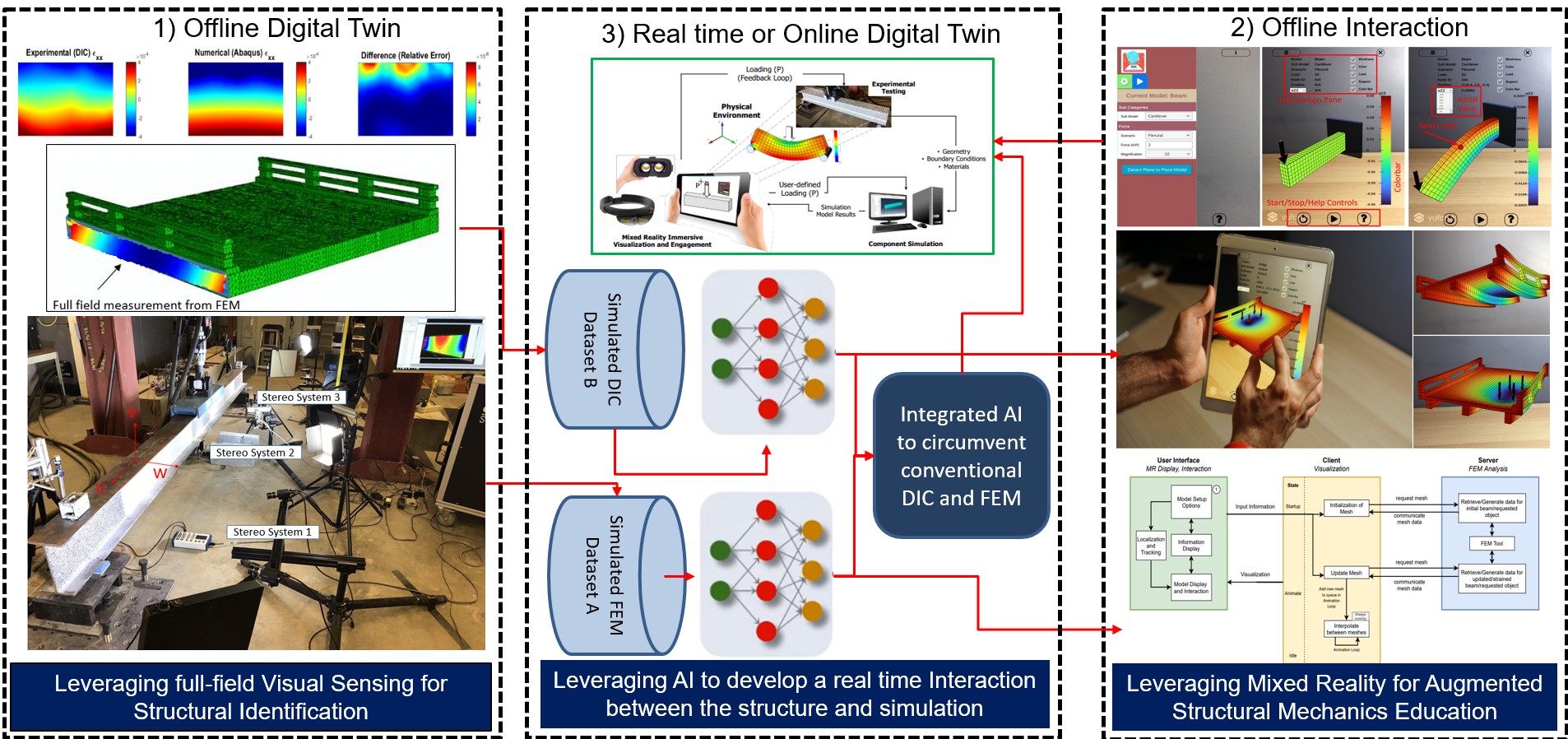
Adaptive digital twins, immersive structural visualization, AR/VR, and cyber-physical infrastructure systems.
Finite element model updating, bridge load rating, structural optimization, testing, and sensor-data integration.
Developed a PINN framework that incorporates electromagnetic wave propagation into neural-network training for subsurface-data prediction.
Based on “Physics-Informed Neural Networks to Predict Subsurface Abnormalities Growth in GPR-NDE Data Using the BEAST Dataset.” Conceptual animation; signals and anomaly evolution are illustrative, not experimental results.
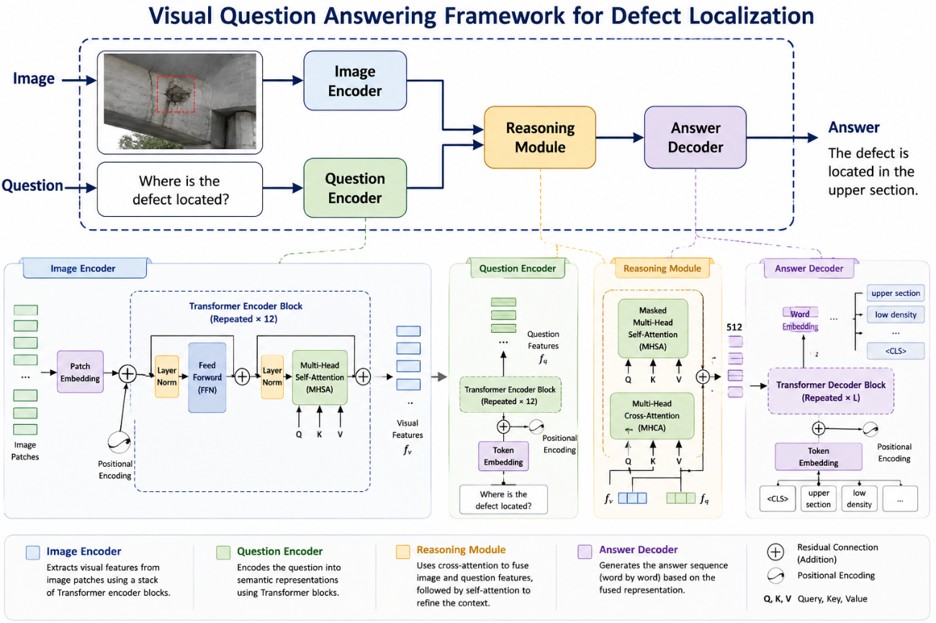
Developed a visual question answering approach for NDE image analysis using deep learning and natural-language generation.
BEAST NDE imagery connects visual inspection patterns with expert-written descriptions and question–answer pairs.
Overview of the paper’s two model pathways. The report found stronger results for focused VQA responses than for long-form captions. This animation uses illustrative maps and example text; it is not a live diagnostic model. Map colors depend on the NDE modality and scale.
Reconstructing hidden defects in steel coupons from full-field surface measurements. A finite element model updates element stiffness through a regularized SIMP formulation and the method of moving asymptotes (MMA), minimizing the mismatch between computed response and experimental 3D digital image correlation data.
Illustrative reconstruction inspired by the paper; animated fields and iterations are schematic, not a live FE/MMA solve or recorded experimental results. Specimens have backside recesses, not through-holes. The threshold controls classification of the illustrative stiffness field.
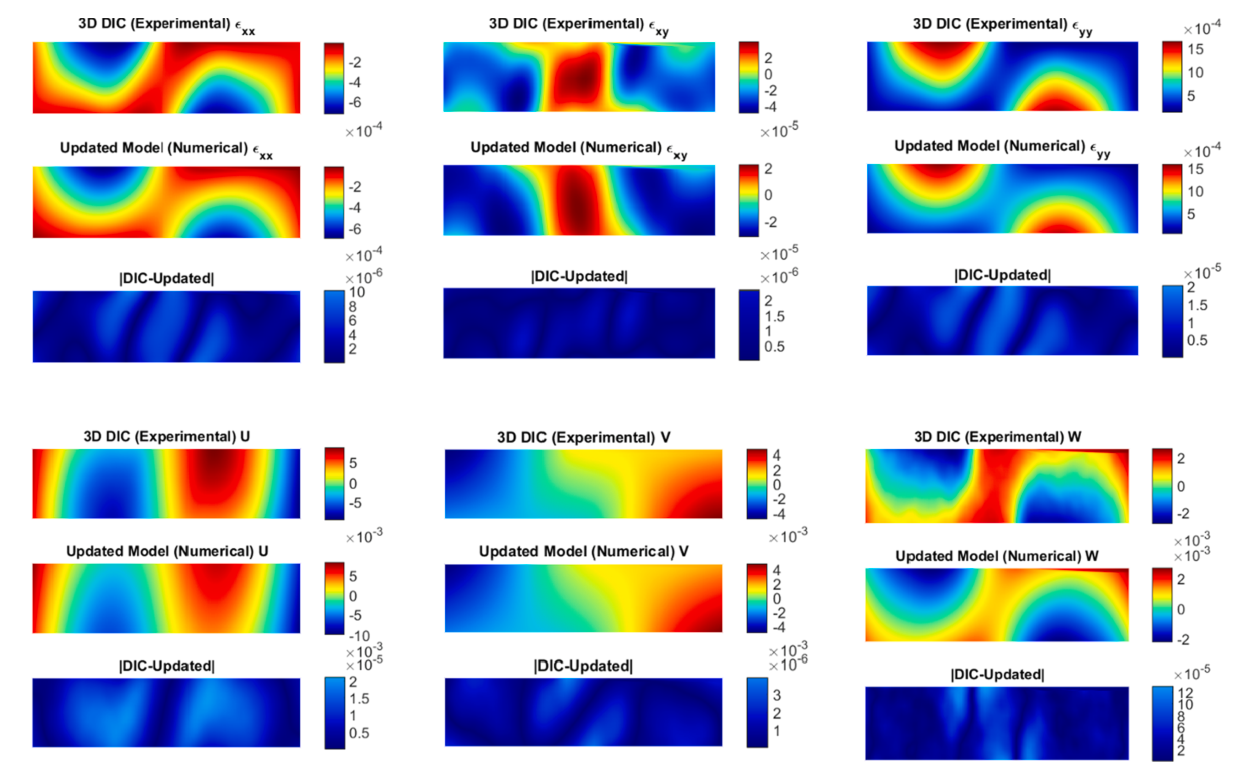
Read the study ↗ · Dizaji, Alipour & Harris · Engineering Structures 230 (2021), 111712
Developed full-field image-based approaches using 3D digital image correlation, topology optimization, and laser scanning for structural identification and damage assessment.
Based on Dizaji, Harris and Alipour (2022), “Integrating visual sensing and structural identification using 3D-digital image correlation and topology optimization to detect and reconstruct the 3D geometry of structural damage.” The study uses full-field optical measurements and an inverse finite-element problem on steel beams. Animation, defect geometry, and mismatch progression are illustrative, not experimental results.
Developed finite-element-model-driven strategies combining field measurements, bridge testing, and sensor data for load rating.
Based on the supplied paper, “Automated Finite Element Model Updating-based Load Rating of Bridges with Incomplete As-Built Information by Integrating Numerical data with Sensor-Based measurement.” The study evaluated two concrete slab and two T-beam bridges, treating available details as unknown and using plans as a comparison baseline. The hybrid method combined local static and global vibration response. The moving truck, response curves, and updating progress are illustrative; this preview does not compute a bridge rating factor.
Developed a hybrid-attention CNN–ConvLSTM model to estimate modal frequencies from structural vibration videos, transferring knowledge from simple beams to an independent turbine blade using limited data.
Dizaji, Mao and Haile (2023), “A hybrid-attention-ConvLSTM-based deep learning architecture to extract modal frequencies from limited data using transfer learning.” Frequency values reproduce the paper’s DLVM estimates in Tables 2–3. Added mass mimics a damaged condition; reference frequencies for that test were available only for modes 1, 2, 4 and 5. Animated motion and feature flow are illustrative. This preview does not analyze uploaded videos.
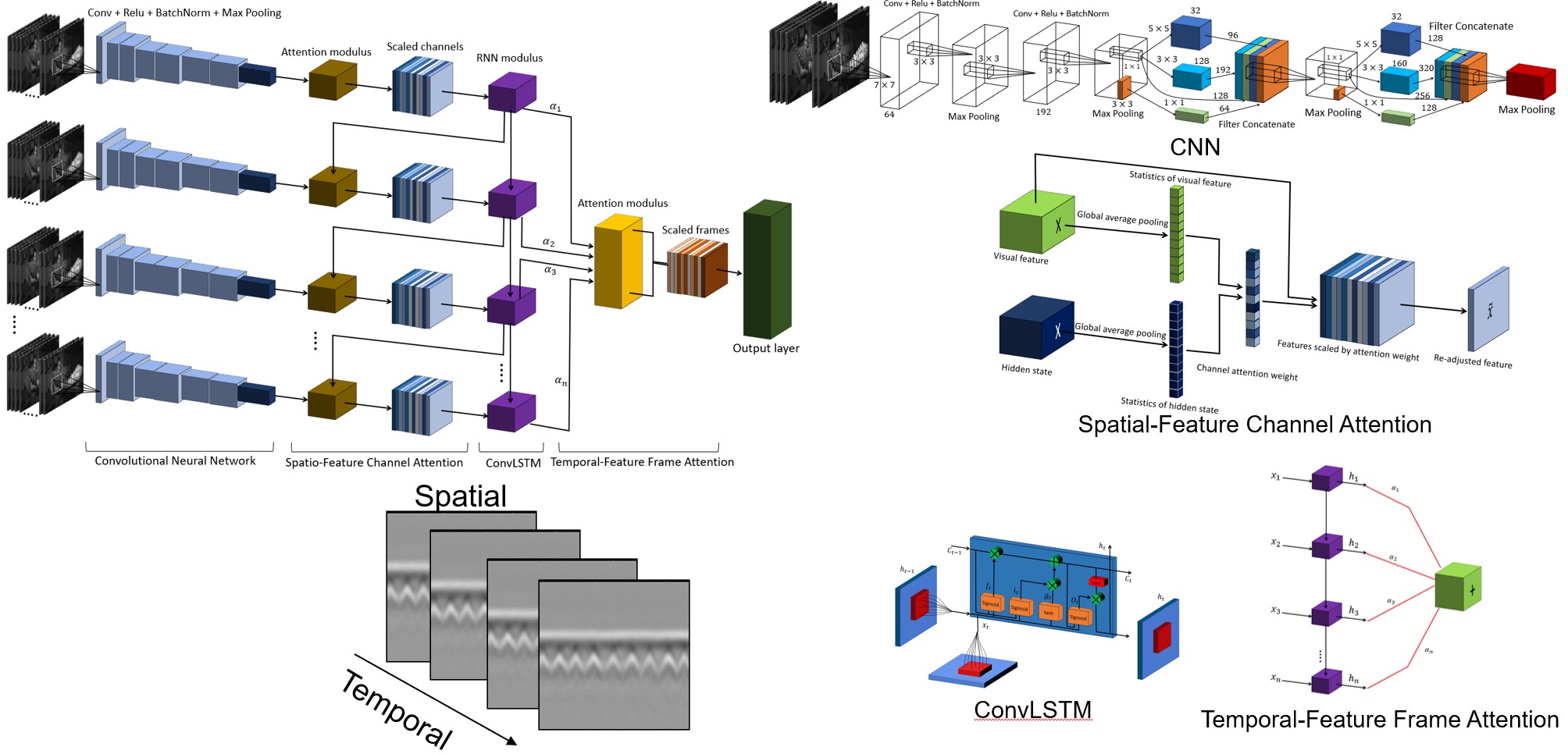
Follow four representative time steps through the shared CNN, channel attention, ConvLSTM, and frame attention. Select a stage to explore it, then adjust the weights to see how features are emphasized.
Inspect three representative channels. Change a gain z to emphasize or suppress its feature response.
Adjust illustrative attention scores. Softmax converts them into normalized weights α across the four shown time steps.
Based on Figure 4 and Sections 2.4–2.5 of Dizaji, Mao & Haile (2023). The four rows stand for a longer video sequence; the CNN shares its weights across time. Three visible channels, feature responses, gains, and attention scores are illustrative. In the trained model, attention weights are learned, with SFCA informed by the previous ConvLSTM hidden state. This animation explains the architecture; it does not run the trained model or calculate physical frequencies. Read the paper ↗
Investigated a passive recentering damper combining NiTiHfPd shape memory alloy bars and friction springs, using material tests and nonlinear seismic analyses of six- and nine-story steel frames.
Based on Farzad Shafiei Dizaji and Mehrdad Shafiei Dizaji, “A Novel Smart Memory Alloy Recentering Damper for Passive Protection of Structures Subjected to Seismic Excitations Using High Performance NiTiHfPd Material.” Material and spring tests informed the proposed device and numerical building studies. The paper calls for further experimental validation of the complete device. This animation illustrates the mechanism and residual-drift concept; it does not reproduce quantitative test or building-analysis results.
Developed an Extended Preisach Neural Network that combines deteriorating-stop memory neurons and sigmoid neurons to identify nonlinear hysteresis, including asymmetric, non-congruent, and rate-dependent behavior.
Farrokh, F. S. Dizaji and M. S. Dizaji (2022), “Hysteresis Identification Using Extended Preisach Neural Network,” Neural Processing Letters. The loop examples and animated signals are schematic, normalized illustrations of the capabilities discussed in the paper. This preview does not run a trained EPNN or reproduce experimental data.
Co-developed a neuro-membrane model coupling neurons with nonlinear dynamic finite elements. Each finite neuro-element converts local displacements into distributed traction, connecting neural activity with mechanical response and plasticity. The study examines neuron type and cell size.
Open interactive demonstration in full screen ↗ · Read the paper ↗
Co-developed a learning approach for Dynamic Plastic Continuous Neural Networks (DPCNNs), combining synaptic-weight optimization with selected material-property updates in a plastic base plate. The medium transmits information through wave propagation and contributes time delay and history dependence. The interactive extension below connects 200 neuro cells one-to-one with a 20 × 10 mesh displayed as a single layer of 3D elements.
Open interactive demonstration in full screen ↗ · Read the paper ↗
Proposed a hybrid learning strategy combining particle swarm optimization (PSO) with L-BFGS-B refinement for continuum neuro-skin networks. The technical manuscript demonstrates four regional design parameters; this interactive extension gives every element in a 200-cell mesh its own independent parameter. A single layer of 3D elements includes a 20-cell damaged area with reduced stiffness, and visualizes the full learning process.
Applied engineering · Field testing · Bridge assessment
VDOT / VTRC · University of Virginia · Final report · May 2020
Assessing bridge load-carrying capacity when drawings and structural details are incomplete. This collaborative project combined field measurements, finite element model updating, and vibration-based identification to estimate unknown structural properties and support analytical load ratings.
War Branch, Smacks Creek, Flat Creek, and Brattons Creek bridges: two reinforced concrete slab bridges and two T-beam bridges.
War Branch Bridge instrumentation layout for live-load testing, showing strain gauges, string potentiometers, and tiltmeters.
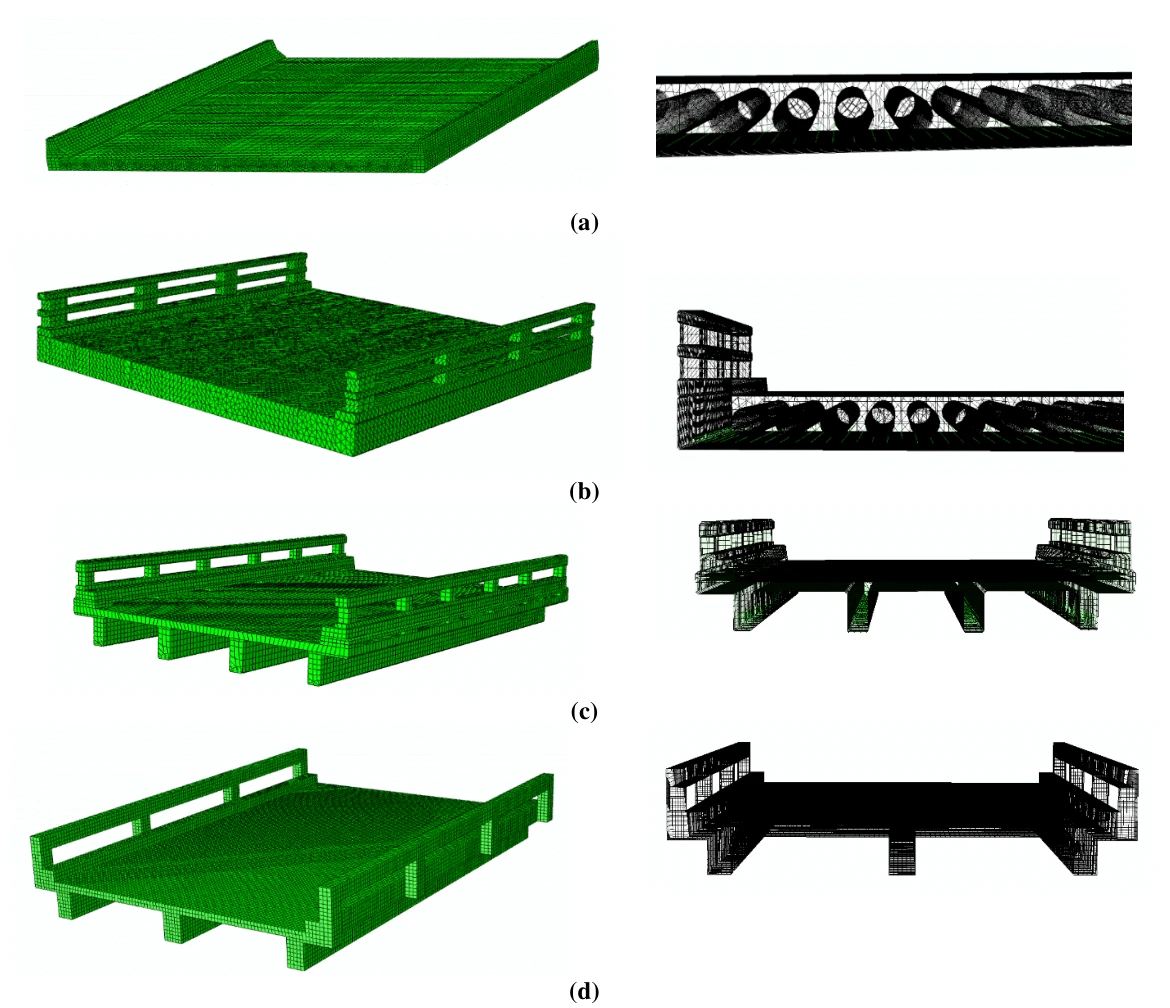
Solid and wireframe representations of the four study bridges, used to represent structural geometry and investigate unknown details.
Static, vibration, and hybrid model-updating approaches connect measured bridge response with calibrated analytical load ratings.
Across the four study bridges, ratings from finite element model updating were equal to or up to 17% lower than conventional calculations. The simplified vibration-based method produced differences from −16% to +16%. The study also demonstrated the feasibility of using a limited number of sensors for these methods.
Source: Harris, Ozbulut, Bagheri, Shafiei Dizaji, Ndong & Alipour, Load Rating Strategies for Bridges With Limited or Missing As-Built Information, FHWA/VTRC 20-R27 (May 2020). Figures reproduced from the report; © 2020 Commonwealth of Virginia.
VDOT Richmond District · VTRC · University of Virginia
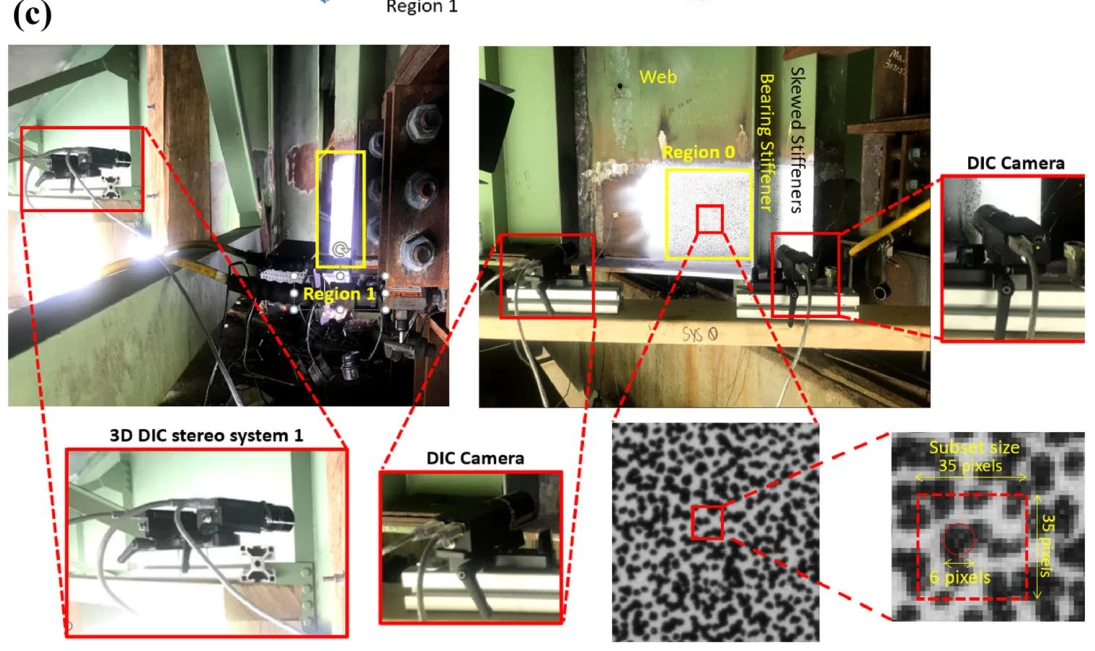
A field investigation of a repaired steel girder on the Mecklenburg Bridge, following earlier web buckling and crippling. Stereo-camera 3D digital image correlation captured full-field deformation during the lowering of the beam onto its bearing, supported by handheld laser scanning and conventional strain gauges.
I-85 over U.S. Route 1 in Mecklenburg County, Virginia, showing the bridge and the location of the girder under investigation.
Two 3D-DIC systems monitor the repaired web panel and tail-end region as the girder is lowered onto its bearing.
Measured out-of-plane displacement over the web panel (Region 0) at the end of the lowering sequence, revealing spatial response across the observed surface.
The ABAQUS model shows the girder geometry, mesh, loading, and support conditions (a), followed by vertical strain contours near the repaired beam end (b). The analysis supports the order of magnitude of the measured strains; differences from 3D-DIC results reflect model approximations and uncertainty in boundary conditions.
A handheld laser scanner captures the girder web surface while the connected laptop displays the scan data. The reconstructed geometry complements 3D-DIC measurements in evaluating the repaired region.
Surface scans collected before lowering and two weeks afterward, with a deviation analysis comparing the reconstructed beam-end geometry.
The monitored beam end showed no evidence of renewed local buckling following the lowering sequence. Full-field measurements and scan comparisons supported evaluation of the repaired region. The 3D-DIC results also enabled back-calculation of dead-load sharing, with conclusions limited to the single beam location studied.
Source: Dizaji, M. S., Harris, D. K., Kassner, B., & Hill, J. C. (2021). Full-field non-destructive image-based diagnostics of a structure using 3D digital image correlation and laser scanner techniques. Journal of Civil Structural Health Monitoring, 11, 1415–1428. Figures reproduced from the paper; selected panels are identified above. © Springer-Verlag GmbH Germany, part of Springer Nature 2021.
Hampton Roads, Virginia · Full-scale field load testing
A field evaluation of five prestressed concrete girder spans using digital image correlation (DIC) and a cable-suspended reference (CSR) system. The testing addressed selected spans that did not pass load rating, with six VDOT tandem dual dump trucks filled with gravel providing controlled loading.
Work took place approximately one mile offshore, where an open-water setting offered no land-based fixed reference. The team installed instrumentation during the day and tested at night to minimize traffic disruption. Modified GoPro cameras mounted at pier caps observed midspan targets for DIC displacement measurements.
The I-64 crossing between Norfolk and Hampton, providing the setting for the five-span field evaluation.
The field team accesses the girders over open water to install instrumentation before nighttime load testing.
Modified low-cost GoPro cameras mount at the pier cap and observe targets at midspan for DIC measurements.
Truck Configuration 2 illustrates the transverse loading position used for the example load-test results.
Example Load Case 2 deflection profiles across the bridge cross section for repeated runs measured using DIC.
Example Load Case 2 deflection profiles measured with the cable-suspended reference system on a different tested span.
The presentation documents cross-section deflection profiles under Truck Configuration 2, including DIC results for Westbound Span 34 and CSR results for Westbound Span 31. These plots illustrate measured response across repeated runs on the respective spans.
Source: supplied project presentation, Case Study 1 – Load Testing Hampton Roads Bridge Tunnel, slides 1–4. Photographs, loading diagram, and result plots selected from the original slides.
Varina-Enon Bridge · Field monitoring · 3D digital image correlation
Continued monitoring of bridge response to special permit loads using 3D digital image correlation. The field work connects camera-based measurements with structural response assessment, using patterned surfaces to track deformation over an observed area.
The presentation documents access to the bridge interior, measurement regions at different positions along the span, and the camera and lighting setup used in the monitoring campaign.
Project overview showing the bridge and illustrative full-field response maps included in the presentation.
Field photographs identify the access point and patterned measurement surfaces near the beginning and middle of the monitored span.
Camera and lighting equipment face a speckled surface prepared for digital image correlation measurements inside the bridge.
An interior field photograph documents the working space and instrumentation arrangement for the monitoring campaign.
Source: supplied project presentation, Case Study 3 – Continued Monitoring of the Varina-Enon Bridge, slide 1. All four pictures selected from the original slide.
Research Gallery
Selected visual summaries of my research in artificial intelligence, nondestructive evaluation, structural sensing, deep learning, mixed reality, and adaptive digital twins.
Research Development & Funding
Selected funded and submitted proposals, alongside a PhD qualifying-examination proposal, spanning AI-based damage prediction, digital twins, and infrastructure assessment.
NRC Research Associateship Program
Role: Principal Investigator (PI)
CCI–Smart Cities Program, University of Virginia
Role: Supporting contributor (partial assistance)
NSF EAGER
Role: Supporting contributor (partial assistance)
Proposal in partial fulfillment of the PhD qualifying examination
Role: Principal Investigator (PI)
Submitted to BRAC
Role: Co-Principal Investigator (Co-PI)
Selected Honors · Fellowships & Awards
Additional selected honors: ASCE Student Fellowship ($1,000), ASNT travel grant ($1,000), ACI travel stipend ($1,000), UVA CEE travel award ($1,500), UVA Postdoc Symposium Best Presentation ($100), UVA Alumni “Hoos Coming Back” fund ($500), and iDICs travel fellowship ($400). Amounts are as recorded in the CV; nominations and travel stipends are not necessarily cash prizes.
Research
Turner-Fairbank Highway Research Center · Federal Highway Administration
University of Virginia · Engineering Systems and Environment
University of Massachusetts Lowell · Mechanical Engineering
University of Virginia · Engineering Systems and Environment
Experimental research · Instrumentation
Explore the instruments and systems featured in my laboratory presentation, from structural testing and optical sensing to data acquisition and immersive visualization.
Digital image correlation
Workstation and analysis display for digital image correlation.
Browse the thumbnails or choose a category. Use the arrow keys while browsing the gallery.
Education
Technical Skills
 Python
 MATLAB
 TensorFlow
 PyTorch
 Scikit-learn
Graduate Research
Doctoral Research · University of Virginia
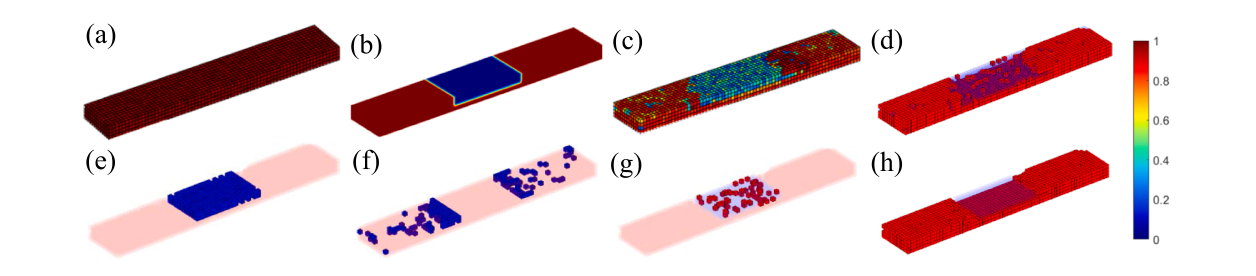
Four connected element layers with no gaps. Two rectangular recesses on opposite edges follow the reference figure; only the top two layers lose elements.
Stereo 3D-DIC · full-field observations
Inverse model · topology refinement
Top two layers optimized · bottom two preserved
Start with a uniform specimen; play or scrub to reveal the hidden region.
Ph.D. Dissertation · University of Virginia
Can surface motion reveal damage hidden inside a structure? My dissertation combines stereo 3D digital image correlation, finite element model updating, and topology optimization to identify subsurface defects and reconstruct their three-dimensional geometry from full-field surface measurements.
Read Ph.D. Dissertation ↗M.Sc. research · Neural networks & structural dynamics
How can a neural network learn a dam’s response to an earthquake? This research develops a dam-specific neuro-modeler trained on finite element simulations. A moving window of ground acceleration and feedback from the previous crest response allow a feed-forward network to represent nonlinear, history-dependent behavior. The paper investigates the Koyna, Pine Flat, and Sefid-Rud concrete gravity dams.
Choose a neuron to inspect its weighted sum and activation.
H1–H2: linear · H3–H8: tanh
Analyze each dam with a nonlinear finite element model using a smeared crack formulation. Collect crest displacement and velocity under training excitation.
Adjust connection weights with back-propagation. Use acceleration history and previous response as inputs to learn the next response.
Compare the trained network with finite element analyses under earthquake excitations excluded from training, including near- and far-field events.
Publications
Refer to Google Scholar to access to all papers.
Research Software & Educational Technology
Mobile mixed-reality structural mechanics applications developed collaboratively at the University of Virginia, as described in my ASEE conference publications. These animated demonstrations illustrate the published concepts rather than reproducing original app screenshots.
UI/UX · Augmented Reality
Explore a bridge model through a mobile augmented reality interface that brings structural analysis results into the surrounding physical space.
This recording demonstrates my augmented reality structural visualization work. The mobile interface offers element, member, and system analysis views. In the bridge example, a three-dimensional model appears in the camera view, allowing the user to inspect it from different viewpoints.
The demonstration shows a finite element mesh, load and support indicators, and color-coded structural response contours. On-screen controls switch between response components, including strain and displacement, while node information connects the visualization to locations in the model. This approach helps make structural behavior easier to explore and explain in engineering education and design discussions.
Our released STRUCT-AR mobile app visualizes finite-element structural models in the real environment, including loading, deformed shapes, stress distributions, and mesh views. The animated demonstration below illustrates the same teaching concept.
Related publication: Alipour, Harris, Dizaji, Bilmen & Zeng (2021), “Leveraging Mixed Reality for Augmented Structural Mechanics Education,” ASEE Annual Conference.
An educational augmented-reality approach for visualizing structural behavior and exploring design concepts through interactive three-dimensional models.
Related publication: Yehia, Chao, Lyons, Dizaji & Harris (2022), “A Case Study on Leveraging Augmented Reality for Visualization in Structural Design,” ASEE Annual Conference & Exposition.
The STRUCT-AR store links above open the released application. The rotating 3D website animations are illustrative browser-rendered demonstrations, not live instances of the mobile app.
Academic Teaching
My teaching connects structural engineering fundamentals with numerical modeling, experimental mechanics, computer vision, and hands-on design. I have supported graduate and undergraduate instruction, laboratory education, and interdisciplinary research mentorship.
CE 5340 · Advanced Topics in Structural Engineering
Co-instructor with Professor Jose Gomez. Developed advanced course modules, organized the syllabus and course project, and delivered lectures on numerical analysis and finite element concepts. Graduate-level instruction included in-person and web-based delivery.
CE 3330 · Introduction to Design of Structural Systems
Co-developed the syllabus and course project, organized instructional modules on computer vision for structural analysis, and supported student project planning and progress.
CE 3330 · Structural Systems Laboratory
Coordinated experiments and project activities using MTS testing equipment, 3D printing, digital cameras, and digital image correlation. Guided problem-solving sessions, exercises, and quizzes.
Introduction to Structural Optimization
Contributed to syllabus and course-project development, taught MATLAB-based computational modules, and guided problem-solving sessions, quizzes, and exercises.
Course Syllabus · Fall 2019 · University of Virginia
Matrix structural analysis through the direct stiffness method, virtual work, and computational implementation. Instructors: Jose P. Gomez, P.E., Ph.D., and Mehrdad S. Dizaji.
Prerequisite: CE 3300 Structural Mechanics or equivalent.
Course focus: Relate external loads to member forces, deformations, and global displacements using equilibrium, force–deformation relationships, and compatibility. Formulate element stiffness matrices, assemble the global stiffness matrix, and solve structural systems with MATLAB, Mathcad, and Excel.
Topics: Statics and matrix algebra; virtual forces and displacements; force and displacement methods; planar trusses, beams, and frames; symmetry, support settlements, releases, and temperature effects. Time permitting: three-dimensional systems, nonlinear behavior, and an introduction to finite element analysis using ABAQUS.
Assessment: Homework 10%; Test 1 20%; Test 2 20%; Computer Project I 25%; Computer Project II 25%.
Recommended texts: Matrix Analysis of Structures (Kassimali); Matrix Structural Analysis (McGuire et al.); Matrix Analysis of Structures (Sennett).
Mentored and collaborated with undergraduate, graduate, and visiting researchers at UVA on adaptive digital twins, mixed-reality structural mechanics education, computer vision, and structural identification.
Contact
I am interested in research and professional opportunities involving structural engineering, AI, digital twins, structural health monitoring, computer vision, and nondestructive evaluation.
Beyond Engineering
Outside engineering, I enjoy strength training and the discipline of working toward personal goals.
A moment from my upper-body strength training.
Building lower-body strength through consistent training.
Bodyweight training as part of my gym routine.
Working on upper-body strength with a spotter.